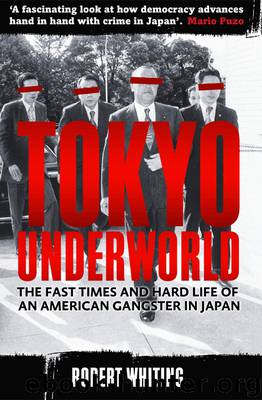
Tokyo Underworld by Robert Whiting
Author:Robert Whiting
Language: eng
Format: epub
ISBN: 9781780335179
Publisher: Constable & Robinson
DEA CULTURAL WALL
Like novice American businessmen in Japan trying to figure out the distinction between a gift and a bribe, US crime investigators on the trail of lawbreakers in Japan encountered their own cultural brick wall. Chasing down drug dealers was a particularly difficult task. FBI Director William Sessions would later testify to a Senate committee that US authorities believed that Japanese gangs were controlling 90 percent of the stimulant trade in Hawaii – peddling drugs brought in from the Golden Triangle and using the profits to buy back firearms, which they would sell back home at a 1000 percent markup. In fact, Attorney General Robert Mueller told the committee that the Hawaiian branch of the TSK, or the Toa Yuai Jigyo Kumiai (East Asia Friendship Enterprises Association), as it was now known, controlled most of the business in crystal methamphetamine or ‘ice’ produced in Korea and Taiwan – which, interestingly, answered the question of what some members of that organization had been doing with themselves in the years since Lockheed bust. But authorities in Japan were little help in investigations.
For example, Japanese police did not follow the practice, routine in North America and Europe, of carrying out ‘controlled deliveries’ – persuading drug couriers whom they have caught to carry on with delivery to the next person in the chain. Nor did they conduct ‘controlled buys’. They did not even purchase drugs on the street to gain an accurate idea of the supply available. Japan’s Criminal Code prohibited the authorities from participating in such activities and from conducting any other sting-type operations, including for most intents and purposes wiretapping (until a 1999 law eased restrictions on the latter). Undercover cops could observe and prevent. That was all. And then they were required by law to put perpetrators behind bars immediately, as one Nicola Koizumi was to discover.
Upset because a member of his family had become ill from drug addiction and hepatitis (from an expedition to the Golden Triangle), he had decided to take action when the son of an ambassador from a Southeast Asian country approached him with three kilograms of white powder in search of a buyer. In a misguided effort to lay a trap, he took a plainclothesman to the dealer’s residence, introduced him to the dealer, and was promptly arrested. He spent three days in the Tokyo Detention House trying to convince police he was not an accomplice.
The Japanese police believed that American-style undercover tactics would also upset the underworld wa – thereby lessening the chances for the poor misguided but redeemable criminal ever to be steered back onto the straight and narrow. Moreover, there was the implicit belief that a policy of self-regulation by organized crime, as much as was reasonably possible, had its uses in maintaining order and discipline in certain fields like the gang-run entertainment industry.
Thus, the Japanese police naturally resented a US Drug Enforcement Agency sting conducted in 1984 on Osakan gangsters who had been selling amphetamines for guns in Honolulu. DEA agents had entered Japan without requesting the approval of Japanese authorities.
Download
This site does not store any files on its server. We only index and link to content provided by other sites. Please contact the content providers to delete copyright contents if any and email us, we'll remove relevant links or contents immediately.
Mindhunter: Inside the FBI's Elite Serial Crime Unit by John E. Douglas & Mark Olshaker(9356)
Wiseguy by Nicholas Pileggi(5801)
Room 212 by Kate Stewart(5136)
Hitman by Howie Carr(5103)
Secrecy World by Jake Bernstein(4762)
Killers of the Flower Moon: The Osage Murders and the Birth of the FBI by David Grann(4454)
Papillon (English) by Henri Charrière(4281)
Breaking Free by Rachel Jeffs(4228)
Killers of the Flower Moon by David Grann(4067)
Say Nothing by Patrick Radden Keefe(3994)
American Kingpin by Nick Bilton(3897)
The Secret Barrister by The Secret Barrister(3719)
Molly's Game: From Hollywood's Elite to Wall Street's Billionaire Boys Club, My High-Stakes Adventure in the World of Underground Poker by Molly Bloom(3544)
Mysteries by Colin Wilson(3463)
In Cold Blood by Truman Capote(3393)
Signature in the Cell: DNA and the Evidence for Intelligent Design by Stephen C. Meyer(3143)
I'll Be Gone in the Dark by Michelle McNamara(3089)
Rogue Trader by Leeson Nick(3054)
Bunk by Kevin Young(3007)
